Resources
For When You Need Help NOW
YOUTUBE VIDEOS
Enjoy a wide range of YouTube videos below to find relief fast!
Yoga For
Back Pain
Help! I Just Threw
Out My Back!
Yoga
For Runners
Neck and Back Pain Relief (Part 1)
Why Your Hip Might Be Causing Your Knee/Ankle/Foot Pain
Dr. Hannah’s Top 4 Glute Activation Exercises to Reduce Back Pain
Dr. Hannah’s Top 4
Strength Exercises
for Runners
Dr. Hannah’s Top 4
Miniband Exercises
for Runners
READ OUR BLOG
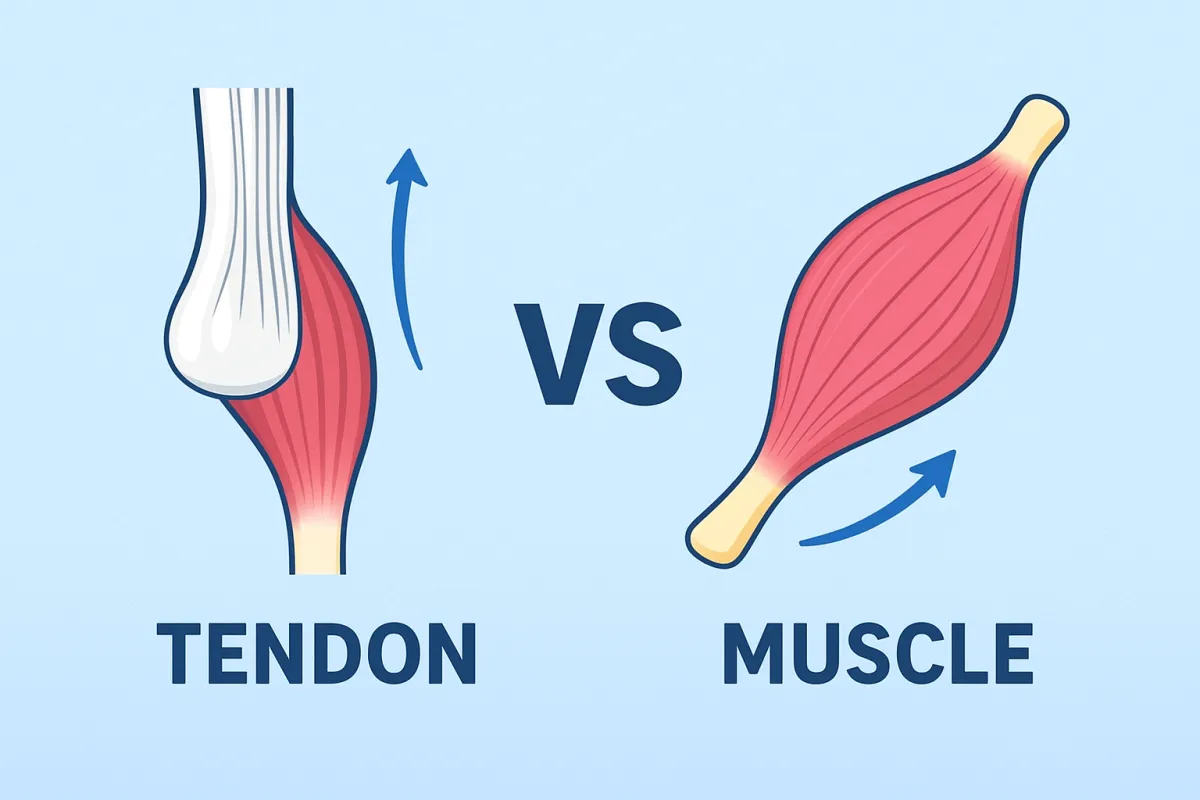
Tendon Training vs. Muscle Training
Tendon Training vs. Muscle Training: Why They’re Not the Same
Introduction
At Revive Physiotherapy, we help you develop a resilient and durable body. This goes beyond just strengthening muscles. We help you build strong muscles, bones, and tendons, and refine movement patterns to prevent future breakdown. An important principle for an overall resilient body is that muscle training and tendon training are not the same thing.
Muscles and tendons may work together, but they develop differently and require different types of exercise to thrive. Everyone is familiar with training muscles, but tendons? That’s where things get tricky.
In this post, we’ll cover:
The anatomical and biomechanical differences between tendons and muscles.
What type of exercise is best for tendons.
Training strategies to maintain strong muscles and elastic, springy, injury-resistant tendons.
Muscle vs Tendon: Designed for Different Jobs
Muscles: The Force Producers
Muscles create movement. They are:
Highly vascular → heal and adapt quickly.
Dynamic and versatile → grow in size and strength when challenged.
Neural powerhouses → train to recruit fibers efficiently.
Role of muscles: create force.
Tendons: The Force Absorbers
Tendons are dense, rope-like collagen strands that connect muscle to bone. They are:
Poorly vascularized → healing and adaptation are much slower.
Stiff yet elastic → made to store and release energy like a spring.
Adaptable to stress → can change structure and capacity in response to too much or too little stress
Functions of tendons: transmit force, stabilize joints, provide elastic recoil.
How Tendons Are Special: Elastic Recoil
Tendons, unlike muscles, act like biological springs. They store and release energy to make movement into action.
Examples:
Achilles tendon during sprinting → stretches, recoils, and propels you forward.
Patellar tendon during jumping → stores energy on the squat-down, releases explosively as you jump up.
👉 Without proper tendon training, you lose this spring-like efficiency, resulting in slower performance, increased energy cost, and higher injury risk.
How Muscles and Tendons Adapt Differently
Muscles Adapt Fast
Begin to experience growth (hypertrophy) in a few weeks.
Respond to multiple rep ranges and loads.
Tendons Adapt Slowly
Remodel over 12+ weeks.
Require high loads at slow speeds for collagen alignment.
Need plyometric training to remain elastic and efficient.
👉This means muscles get stronger fast while tendons adapt slowly.
Muscles vs. Tendons: Training Principles
Training Muscles
Muscles can be trained in a variety of ways for multiple outcomes.
Hypertrophy, or muscle growth, used to be classified in the rep range of 8-12. Current research shows that muscles can adapt in size and structure to awide range of repetitions (anywhere from 6-25) as long as taken to near failure.
Strength and power. This training style is similar in rep range (3-6) and intensity (heavy!). However, power training involves moving high intensity weight with speed.
Endurance. This is typically lighter weight at high repetitions (>20) taken to fatigue.
Training Tendons
Heavy Slow Resistance (HSR): 3–4 sets of 5-8 reps at 70–85% max - builds collagen durability
Isometrics: 30–45 seconds heavy static holds → reduce pain, prime tendon stiffness.
Eccentrics: Controlled lengthening under load. (heel drops for Achilles, etc.). Eccentrics used to be the gold standard for tendon strengthening. But recent research shows that heavy slow resistance is just as effective and takes about half the time.
Plyometrics (important for elasticity) → restore recoil and efficiency of energy transfer.
Adaptation speed: 8–12+ weeks for stiffness; lifelong plyometric benefits with consistent training.
The Importance of Plyometric Training for Tendons
Plyometrics bridge the gap between tendon strength and performance. It what makes the tendon function without pain at maximum capacity in real life scenarios.
Benefits of plyometric tendon training:
Restores elastic recoil
Enhances shock absorption to protect joints.
Improves energy storage capacity (able to tolerate higher loads before failure)
Boosts coordination and reflex speed (faster load/unload cycles)
Rehab Case Example 1: Achilles Tendinopathy
Phase 1: Isometrics → heavy mid-range calf raises 5 sets of 45 seconds
Phase 2: Heavy Slow Resistance → standing calf raises, 6–8 reps, 3–4 sec tempo at 70% 1RM
Phase 3: Plyometrics → pogo jumps, skipping, bounding.
Phase 4: Return to sport drills → sprints, cutting, sport-specific plyos.
Rehab Case Example 2: Patellar Tendon (Jumper’s Knee)
Phase 1: Isometric wall sits or leg press holds.
Phase 2: Heavy slow decline squats.
Phase 3: Plyometrics → depth jumps, single-leg hops, box jumps.
At Revive Physiotherapy, we don't just help our patients escape pain, we help you become more resilient, durable, and springy! Performance isn’t just about lifting heavier, it’s about building a body that’s efficient, injury-resistant, and built to last.
If you’ve experienced tendon pain or want to train for injury prevention and performance, our team can develop a customized plan to strengthen both muscles and tendons.
📞 Call 954-519-4185 today or 💻 book online to begin building strength, elasticity, and resilience that lasts.

Our one-on-one treatment sessions ensure that you fully understand your body and take ownership of your health so that you can have control over doing the things you love!
Send us a Message
Let's Have a Chat
954 - 519 - 4185
Find us at
2852 E Oakland Park Blvd
Fort Lauderdale, FL 33306


2024 REVIVE PHYSIOTHERAPY | ALL RIGHTS RESERVED