
Read our Blog
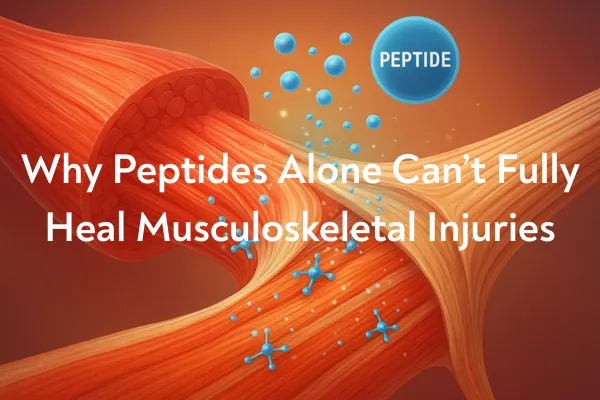
Why Peptides Alone Won’t Completely Heal Musculoskeletal Injuries
Why Peptides Alone Won’t Completely Heal Musculoskeletal Injuries: The Fundamental Mechanism of Progressive Overload.
Introduction
Peptides such as BPC-157 and TB-500 have gained popularity in sports medicine and physiotherapy. Famed for aiding tissue repair, decreasing inflammation and accelerating recovery from musculoskeletal injuries, peptides are frequently touted as game-changers in healing.
We’ve seen at Revive Physiotherapy how peptides may work at the cellular level to support injury rehabilitation. But here’s the real truth: peptides not as a standalone agent will not rebuild strength; it can be incomplete if it doesn’t provide movement efficiency and ready your body for the demands of sport and everyday life.
This is where progressive overload training shows how peptides are crucial to injured tissue recovery, what they achieve as a result of an injury, and why it is extremely important to return the musculoskeletal system back to normal through progressive overload.
What Peptides Can (and Can’t) Do
Peptides like BPC-157 and TB-500 are frequently referred to as “healing accelerators.” Although they expedite tissue recovery from tendon damage, muscle strains and ligament sprain, their effects are mostly of the biological kind — not mechanical.
What Peptides Can Do:
Promote cellular healing and regeneration.
Enhance blood flow and angiogenesis.
Help to promote collagen synthesis; thus making stronger tissues.
Minimize inflammation and oxidative stress.
What Peptides Can't Do:
Revamp muscle strength or tendon load tolerance.
Re-train your nervous system for coordination.
Develop stamina, power, or resiliency.
Get your body ready for competition/sport or training.
Peptides are the fast-forward button for tissue repair. But they speed up biological healing but do not rebuild load capacity — and that’s where more progressive overload kicks in.
Why Load Capacity is Critical During the Recovery
Your load capacity — the amount of weight your body can bear — drops dramatically after an injury. For example:
A tear in your hamstring weakens it.
An Achilles tendon injury decreases stiffness (with a corresponding reduction in resilience).
Rotator cuff injury reduces shoulder stability.
Although peptides can enhance tissue healing by speeding things up, without progressive loading, tissue remains delicate and can easily reinjure. To restore, the need to cope mechanically, neurologically and functionally is needed, and that's something only progressive overload can do.
The Importance of Progressive Overload
Progressive overload is the concept that over a period of time demands on the body increase in order to allow the body to adapt, strengthen and rebuild its resilience. In the field of rehabilitation, this is represented as follows:
Starting Below Pain Threshold.
Exercises where tissues can safely handle load; low-intensity.
Gradual Progression.
The resistance, repetitions or complexity builds as the tissues adapt.
Activity-Specific Loading.
Reintegration of activities resembling running, lifting, CrossFit, tennis or Pilates as necessary.
This process doesn't only rebuild strength and function, confidence and movement effectiveness, but develops resilience for the future.
The Danger of Missing the Progressive Overload
And when athletes use peptides, PRP injections or even surgery on their own — without proper training — the risk of reinjury skyrockets.
Common cycle:
Peptides heal tissue faster.
Pain subsides quickly.
Athletes return too soon to full activity.
Tissue once more breaks down from poor capacity.
👉 Healing a bit sooner ≠ healing fully.
Case Study: Achilles Tendonitis in a Runner
A runner gets Achilles tendonitis and uses peptides to speed up the process of healing. Pain subsides within weeks. So believing they are ready, they restart 5-mile runs at their full speed.
Result? The tendon flares up again.
The trick: no progressive load retraining.
Recovery under progressive overload would include:
Calf raises to increase tendon strength.
Plyometric drills for elasticity.
A graded mileage plan for returning running stress.
Peptides can help, but gradual loading replenishes durability.
How Revive Physiotherapy Combines Peptides & Progressive Overload
With Revive Physiotherapy, you can now get the best in recovery tools combined with our best evidence based training:
Evaluation – Assess injury type, current capacity, and individual goals.
Healing Support – Methods such as dry needling, peptides (when suitable), and hands-on therapy.
Load Progression – Individualized progressive overload that can safely restore strength.
Return to Activity – Reinvigorated confidence & practice through sport-specific training.
This cohesive approach guarantees not only a quicker recovery — but lasting resilience.
Key Points
Peptides are useful for accelerating healing, but they cannot take the place of progressive overload in restoring the musculoskeletal system. Your body needs to be retrained to deal with the kind of stress that could put you back on top.
At Revive Physiotherapy we are there to assist you in:
Recover faster with the right tools.
Reestablish strength and resiliency with progressive overload.
Resume sports, workouts, and life with confidence.
📞 Book a visit to schedule a consultation with us!
💻 Schedule online to begin your personalized recovery program.
👉 More than heal — rebuild your capacity to return stronger.
Our one-on-one treatment sessions ensure that you fully understand your body and take ownership of your health so that you can have control over doing the things you love!
Send us a Message
Let's Have a Chat
954 - 519 - 4185
Find us at
2852 E Oakland Park Blvd
Fort Lauderdale, FL 33306


2024 REVIVE PHYSIOTHERAPY | ALL RIGHTS RESERVED